

Taurus Rising
The running of the bulls of San Fermín

The bones of this piece were orginally published in The Daily Telegraph, Saturday magazine in 2015. Even as it went to print, it felt like a sketch. This iteration gives the subject the longer, slower, fuller treatment it has long merited.
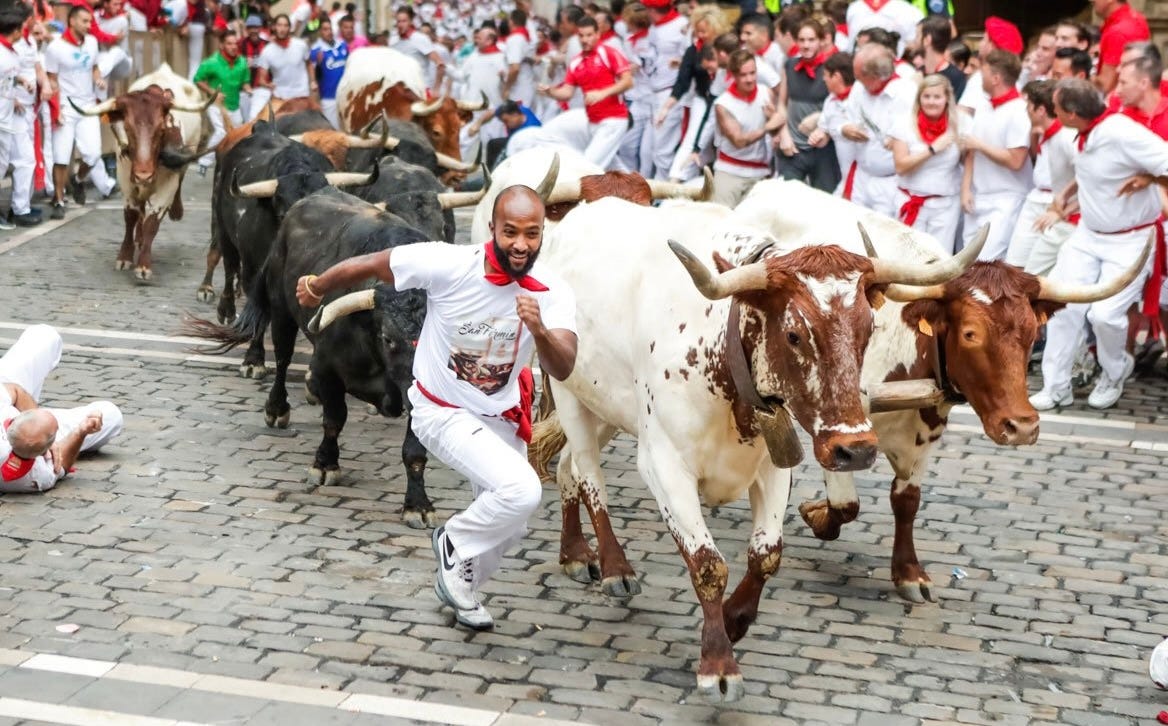
AT SOMEONE’S NOD, I forget whose, we neck our coffees, bin the styrofoam and move as one, picking our way through a whooping, unsteady crowd. We clamber through a barricade intended to keep the underage, the improperly dressed and the obviously wasted off the streets, where the mood is markedly less festive. We, the runners, are out in number, and many of us have been out all night, but fear – let’s call it what it is – has cleared our heads.
There’s some waiting to be done, so we mill around. We might look like protesters if what was in our heads were fit to put on a placard. Soon enough, our fears become nerves and, with our feeble jokes, cracked knuckles and pissoir whistles, we’re not fooling anyone, least of all ourselves.
The thing is, we know what’s coming. Although we don’t really, not exactly, and that’s the problem. This is an unpredictable business. Another 20 minutes pass. I follow some locals down to the start of the course, where a niche in a high wall holds the statuette of a saint. We beseech him to keep us safe, then head back to our “lucky” spots, newspapers screwed tight in our fists.
Not long now. We study our phones, the soles of our trainers, the backs of our hands. To check the time, the company we’re keeping, for signs of wear and tear – searching, as one does in tea leaves or coffee grounds, for confirmation that today isn’t our day and we’d be wiser to duck out and let this madness be. Those of us who care to, and many of us who don’t, make the sign of the cross.
At 8am a rocket sounds. A gate opens in our heads and nightmares briefly swarm. A few beats later a second rocket goes off and panic or preparedness – which is nothing but heavily drilled panic – takes over.
Before we know it, they’re upon us, although we don’t see them immediately. The first wave to hit is human, and that wave – already ragged – breaks as legs give out, unable to outrun six peak-condition fighting bulls and their companion steers
In turn, we move, scattering like dice, trying our luck – some of us keeping pace with the herd or sprinting ahead of it for a few jubilant seconds, while others – others, we hope – succumb to the stampede, falling under feet and hooves, or flatten themselves against the walls, guts sucked in, wishing they were shadows or smoke. A glancing blow from one of these toros bravos will open you up like it’s Christmas.
And so the run continues, section by section, for just over half a mile, the bulls averaging half a ton and 15mph – even on these winding streets – and the runners hoping that whichever god or philosophy they cling to is paying attention. And that medical help is standing by.
YES, I’M IN PAMPLONA, in the Navarre region of northern Spain, and it’s the third day of the 424-year-old festival of San Fermín, which is held each year from July 6 to 14 and has the encierro, or bull run, at its heart. There's a run each morning from the seventh, starting at the foot of the Cuesta de Santo Domingo, where the bulls are released from a corral, and finishing at the Plaza de Toros, where they meet their end in the afternoon.
Most mornings, about 2,000 people take to the streets. They're a mixed bag, the runners, the corredores, the mozos. Many are locals and most of those are Basque, a people whose relationship with the bull runs Minoan-deep. Then come the usual suspects: self-styled daredevils who’ve exhausted their bungee options; and gap-year hopefuls in white tees emblazoned with the logo of the tour operator that marooned them on a wasteland campsite miles out of town, in what it had the gall to call an “executive package”.
Finally, the fiesta faithful – the foreigners, the guiris – whose passions for Spanish culture, cooking and wine, tauromachy, American expat literature and plain old sybaritism bring them back to Pamplona year after year.
I, too, am a recidivist, though this is only my third time back, which in San Fermín terms means I’m still gumming my rusks. My non-fiesta friends who aren’t appalled by my enthusiasm for “that barbaric spectacle” are simply mystified by it, but that’s on me. Outside July, when I’m pressed to explain myself, I hum and haw. I talk about the trench camaraderie of the run, about how the festival feels like a school reunion – perhaps a reformatory school reunion – except no one had their head flushed down a toilet at the San Fermín Academy for Errant Boys.
All of that is true, but it’s not the whole story. Part of me doesn’t want to expose the magic of fiesta to the chill light of language; and the rest knows it would be futile anyway. The magic can’t be recounted – it has to be felt – and the encierros and corridas are merely the most obvious signs that something other is going on.
That “something” is part religious festival, part celebration of Basque and Navarrese culture, part riotous debauch. For nine sleepless days Pamplona – usually a sedate, provincial city of 200,000 – hosts a Club 18 Months-to-90 holiday for more than a million people. Streets, squares and parks can’t move for concerts, readings, folk dances, puppet shows and Basque rural sports. And threading through it all are the brass bands of the 16 peña social clubs, the fiesta’s roving pulse, charm and, occasionally, menace – cheerfully conscripting passers-by into bacchic service.
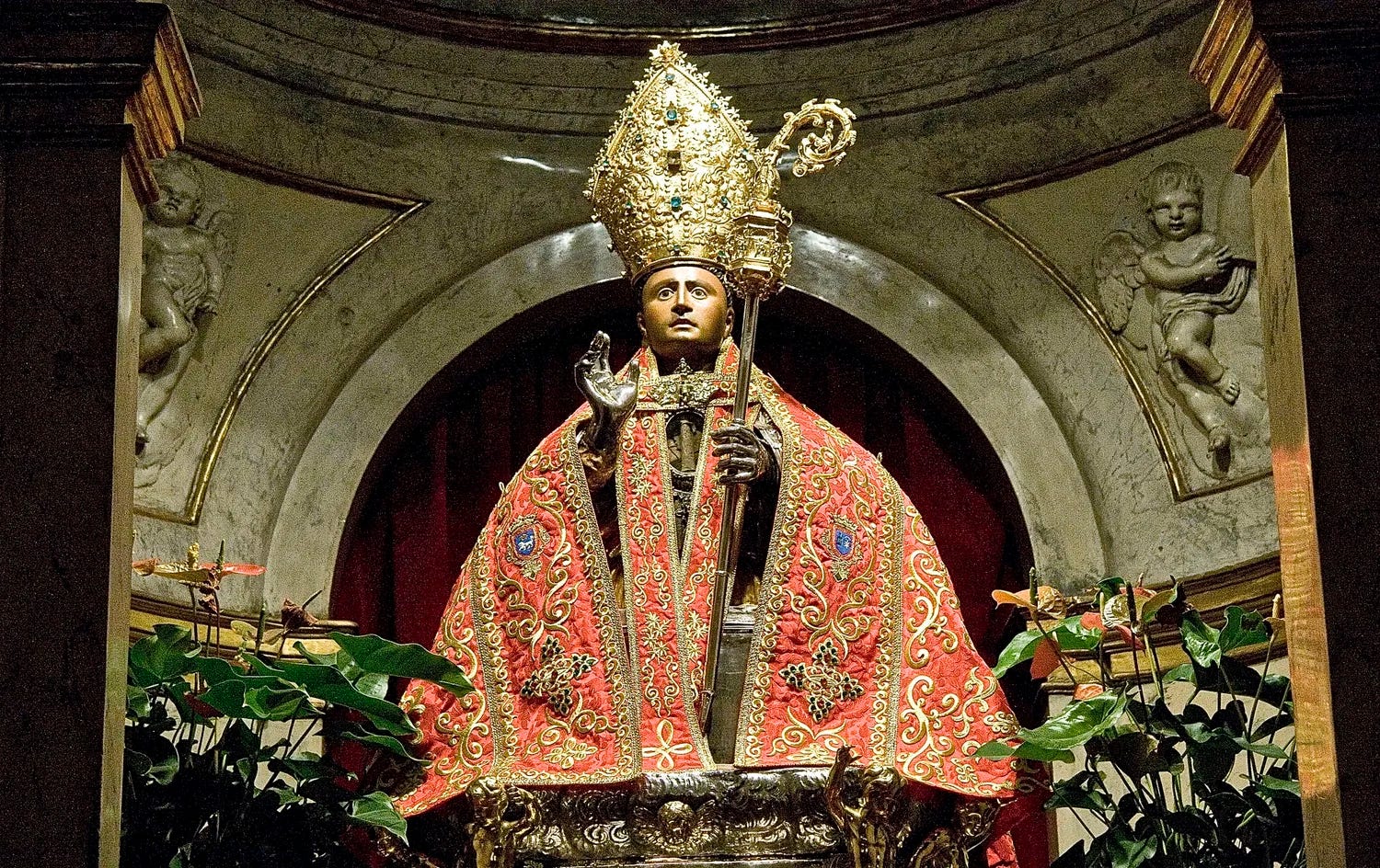
AND IT’S ALL FOR one man. Well, for one reputed man, anyway. San Fermín is a saint – a co-patron saint of Navarre, no less – but what we know of his life before canonisation is split between fancy and conjecture.
The story mostly goes that in Roman Pamplona, in the 3rd century, Fermín, a heathen son of a senator, was converted to Christianity by a disciple of Saturninus (later Saint Saturninus), the first bishop of Toulouse. Though local legend insists he was then ordained and returned to Pamplona as its bishop, the Church places him in Amiens, appointed as its bishop and beheaded there for evangelising on 25 September, 303 AD.
The Abbey of Saint-Acheul in Amiens was founded in 1085, and San Fermín’s body is said to have been discovered in a vault beneath its choir. When relics of the saint were delivered to Pamplona in 1196, the city marked the occasion with an annual celebration. It was first held on October 10, but in 1591 the date was shifted to its current July slot to coincide with the livestock fairs.
The sacred and profane – benedictions and bulls – have been bedfellows ever since, though, contrary to popular belief, it was Saturninus, not Fermín, who was tied to a bull’s feet and dragged to his death. And no one knows quite when the saint’s tiny cape, the capotico, acquired its supposed power to protect encierro runners.
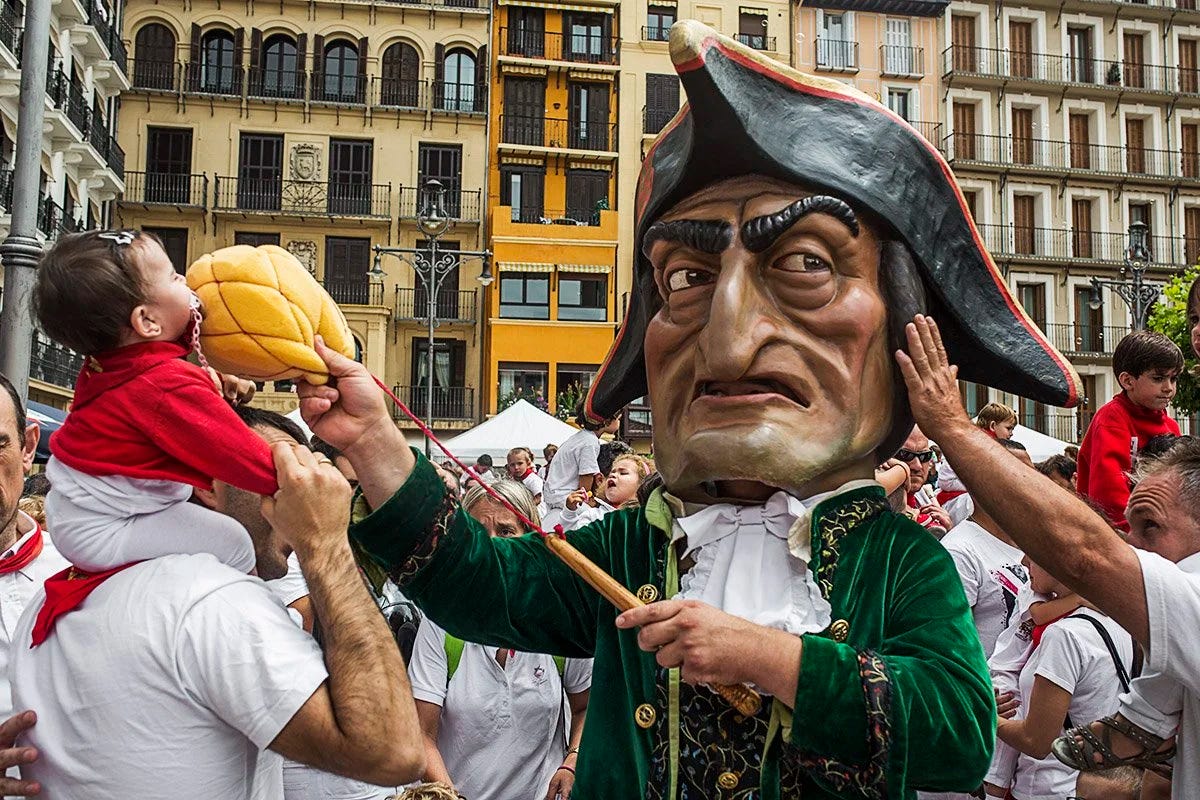
ON THE MORNING of July 7, a polychrome wooden effigy of the saint, together with his relics, is carried from his chapel in the Church of San Lorenzo to Pamplona Cathedral. I watch the cortège make its laboriously deliberate way across the Plaza del Consejo, raising perfectly uniform puffs of dust. This is Pamplona in full pomp: the complete set of religious and civic dignitaries in their best bib and tucker; a royal court of papier-mâché giants with their escorts; the municipal brass band and a choral group ready to unleash a jota.
Beside me, a man in his early twenties unwraps a smile as tentative as his moustache, only to withdraw it when our eyes meet. I offer my name and purpose, but he lets the silence stew for a couple of minutes before surrendering his own. All solemnity – and wearing it like an overcoat in a heatwave – he sighs and declares, complete with air quotes: “David Usher, an American Catholic in his third year at the University of Navarra.”
The university where Usher is studying for a doctorate in medicine and health was established by Josemaría Escrivá, founder of Opus Dei, a conservative Catholic organisation that teaches the secular life can be a path to sanctity. Usher, who admits to being a member, won’t be drawn on depictions of Opus Dei as a secretive group with a taste for medieval self-mortification (notably the cilice, a spiked garter worn around the thigh), but he is “happy” to share his thoughts on Sanfermines.
“It’s a perversion of a religious festival and an affront to good taste. The procession of the saint still moves me, and plenty of others – as it should. Look around: hands on hearts, people crying. But once this is over, Pamplona turns into a den of vice, a place of intoxication, violence and lechery. The streets become rivers of urine and vomit. Tell me, do you come here for that?”
Now, I may not have religion, but I am a great believer in San Fermín, and I’m not alone among the heretic multitudes. Our attachment is worshipful, even if our heaven is vacant.
I first saw the light of fiesta over a bottle of rioja with Larry Belcher, a rodeo rider in Texas turned professor of translation at the University of Valladolid. Belcher has given the whole of his adult life to bulls, books and Spain, and his exuberance is unbroken after 40 years of encierros. He is, for me, Pamplona’s proselytiser-in-chief, and it seems fitting that, with his curtains of white hair, empyrean-blue eyes and highly animated manner, he calls to mind a Dust Bowl preacher. Except that it is always a joy to sit down for one of his sermons.
“To watch Pamplona’s transformation is to witness a marvellous trick. I can’t tell you. This enchanted place seems to materialise out of nowhere, like Brigadoon, and vanish again before the regular world can normalise it. It’s a world unto itself, with its own rules and standards, and it changes everyone who comes near. Hell, it reaches into their souls. A million people each fiesta. Remarkable. Breathtaking. And they keep coming back for that hit of something they can’t find anywhere else.”
Not that you’d get any of that from the press. At best, foreign coverage is luridly cartoonish, painting Pamplona as an open asylum where idiocy and cruelty mingle to the disgust of anyone interested in animal rights. It also tends to report the tramplings, gorings and deaths (there have been 16 fatalities since 1910) with a sniggery relish and an overfondness for the word “karma”.
THE PLAZA DEL CASTILLO, the city’s drawing room, is filling up after the encierro. Families seek coffee and palmeritas in the shade of the arcades. In states of nervous exhaustion, and in clothes that could use a boil-wash, last night’s revellers pass out on the fast-scorching grass. And the runners? They head to a bar. You can pick them out by the minor liberties they take with the dress code: keeping the white trousers, the red pañuelo and the faja sash, they usually switch the white top for a rugby or football shirt – out of superstition, or far more likely, because it makes them easier to spot in the photos of the runs that crowd the souvenir-shop windows.
I stroll to Bar Txoco with a first-timer, a painter and decorator from South Shields built like a caber tosser. Geoff Wanless turned 50 today and the run was his present to himself. When I ask him why, the sound of his voice – a mix of shaken and stirred – is instantly familiar, and laughter bursts out of him whenever it chooses, which is often. Wanless learnt an important lesson this morning: no one is as big as they look. “Why did I do it? It’s hard to remember anything right now. Back home, my standard line was: ‘I’m going to run because I’m having a midlife crisis and can’t afford a Porsche.’”
Looking around, I take a mental register, and within half an hour I’m satisfied that none of my friends is putting the paramedics to work. Cut, yes; bruised, doubtless; but fully anaesthetised by adrenaline and bouncing on their toes, talking at speed and clinking tall glasses of iced cognac and flavoured milk, the traditional post-run tipple – though it packs a punch, it’s more a leveller than a livener, a calm-me-down rather than a pick-me-up.
Pleasantries soon turn to unpleasantries, to the uglier aspects of the morning’s sport; to the strangers who were tossed like salad and had to be stretchered off. There but for the grace of San Fermín go us, eh? Then, with the dangers of our calling safely established, we move on to our own performances, our feats of daring and athleticism. Lacking both in any useful measure, I’m spared the temptation to boast, though I hope my coolness under inquisition sounds a faintly heroic note.
None of us wants a repeat of last year, when “Buffalo” Bill Hillmann, a notable runner who gives beginners “inside track” tours of the course, was gored in the thigh, just shy of his femoral artery.
Hillmann is the last to appear. The 33-year-old Chicagoan, a former Golden Gloves boxing champ, is grinning beneath his trademark duckbill cap like a newsboy who has made the front page of the paper he sells. Beside him, propped against a table, is the stuffed and mounted bust of Brevito, the bull that almost killed him. I’ve heard of matadors decorating their apartments with the heads of their worthier opponents, but never runners.
Hillmann’s relationship with the bulls borders on the devotional, and he has much to thank Brevito for. He wrote his memoir, Mozos: A Decade Running with the Bulls of Spain, while convalescing from his cornada (horn wound). It’s a story of personal redemption in which he strongly identifies with the suelto, or loose bull, a regular feature of the encierro. When a bull is impeded, distracted or loses its footing, it will almost certainly lose its herding instinct and go rogue.
“Running with the bulls turned my life around. Before I came to Pamplona ten years ago, I was in a gang, dealing drugs. I was totally lost. Like a suelto. Full of fear and rage. Lashing out. Capable of terrible violence. The encierro opened my eyes and gave me focus. A good runner can lead a lost bull back to his herd. I wanted to be that runner — to rescue the bulls that rescued me.
“Brevito had a chance to kill me – it was close – but in a way he handed me my life back. I’ve learnt so much here, in Navarre. Spain is the country of my rebirth.”
Hillmann’s words may sound to general readers like sentimental anthropomorphism at its soggiest, but all the regular runners I know have a profound affection for the bulls. It is no ordinary love that accepts its romance must end in blood, of course, but the connection the mozos feel to these fierce creatures is real – sometimes possessive and, yes, if you wish to scoff, protective too.
They take considerable risks in trying to coax sueltos to follow them to the arena, though it isn’t their job: that falls to the pastores, the shepherds in green polo shirts whose role is to defend – with the same cane – both the bulls from interference and the runners from their own bravado. (And it’s worth noting that, regardless of the carnage they create, the bulls are not tranquilised, there is no escape route for runners and Red Cross volunteers will only treat the badly injured when it’s safe to reach them.)
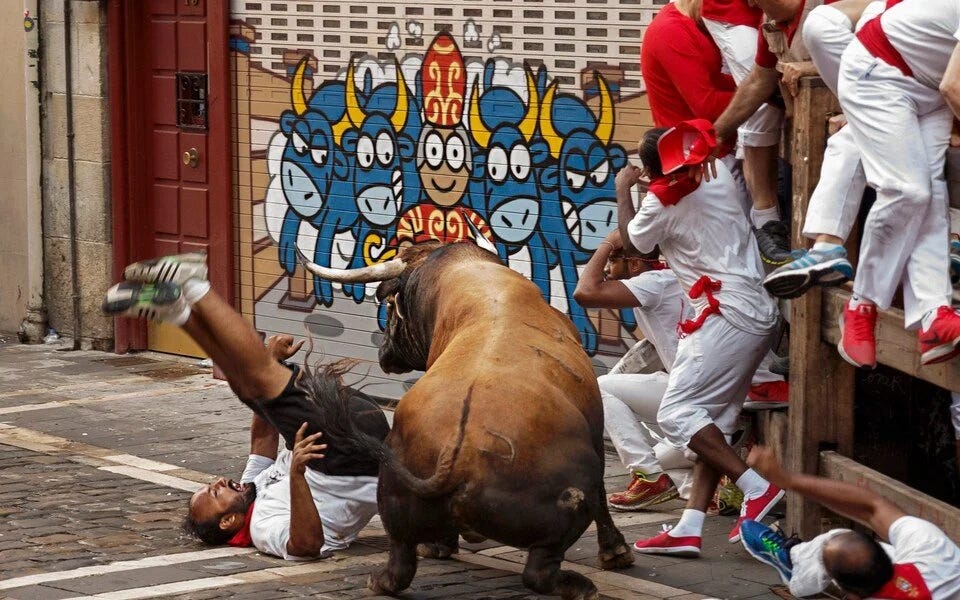
A Cebada Gago bull, making not so merry. Photograph by Daniel Ochoa De Olza
THESE ANIMALS are more than freakish composites of heft and horns. Fighting bulls are bred like racehorses – for speed, certainly, but also aggression and indomitability. To this end, they are raised wild, from the saddle, in the oak forests and grazing lands of the dehesa in central and southern Spain. Toros de lidia (to give them their official title) must come from ranches with confirmed bloodlines, some going back more than a century. Each ranch prides itself on its encaste, its particular lineage, producing bulls that are not only reliably gifted where it matters but distinguished by quirks of temperament all their own.
From July 7, each day of Sanfermines is run and fought by bulls from a different ranch. To appear in Pamplona – one of just eight First Category bullrings in Spain – they must be between four and six years old and weigh no less than 460kg. Just as aficionados have their favourite encastes to watch in the arena (the word aficionado originally meant a bullfighting enthusiast), I know mozos who pick their mornings to run according to which bulls will be joining them – several even bear tattoos of the hierros, or brands, those bulls carry.
Generally speaking, the clearer and more present the danger they pose, the more popular they are – though “popular” is perhaps the wrong word. Heading a fearsome list, each responsible for a death in the past 35 years, are the bulls of Cebada Gago, from Cádiz, which average almost two gorings per run; the Torrestrellas, which killed an American in horrific fashion in 1995, throwing him 20ft into the air; and the Jandillas, from Extremadura, notorious for tossing their heads and slipping their herds, inviting mayhem – their 2004 encierro resulted in a record eight gorings.
The Miuras, which traditionally run on the final day of fiesta, have their admirers too, though they earned their sobriquet “the bulls of death” in the ring, not on the streets, where they are generally fast, nimble and inclined to stay together. They appeal to the historian and aesthete who room with the class-A bonehead inside most runners. Prehistorically proportioned, with a prominent morillo (the muscle mass over the neck and shoulders), they are the only encaste still carrying a significant amount of Cabrera blood – the Cabrera being one of the founding castes of today’s toros de lidia.
FOREIGNERS STARTED running with the bulls here in small numbers in the early 1950s, and a few of them left more than their signature. Matt Carney’s name, though he died almost 30 years ago, is still regularly invoked, his presence felt as if he’d only just bought you a beer. An Irish-American Marine officer who fought at Iwo Jima and later modelled, acted and wrote, Carney ran with a rare, instinctive facility. Graceful, courageous and full of alegría – the unfettered joy of fiesta – he appears in Iberia, James Michener’s travelogue about Spain, and again in The Drifters, the novelist’s potboiler about Vietnam-era backpackers, which spends a chapter in Pamplona.
Some of Carney’s old cuadrilla – younger than him then, in their seventies now – still return each year, and one, Joe Distler, still runs. A New Yorker who teaches English literature in Paris, the “iron man of Pamplona” has scarcely missed an encierro since 1968.
Carney’s daughter, Deirdre, 37, a teacher and photographer, only took up running recently. Women weren’t permitted to enter the encierro before 1974 and even now make up only a small minority of participants. As there’s little point pretending that machismo isn’t the dominant culture here during San Fermín – the testosterone can leave an acrid taste in the back of my throat – I ask, given a recent spate of sexual assaults, whether Carney fille ever finds the atmosphere simply too toxic for women.
“Look, this is a fiesta for everyone – for families, the elderly, children, mothers. You won’t see such a mix of people at any other festival, and at all hours. I feel incredibly safe here, though I’m older now and no longer in the backstreets at 3am. In the 1990s, when I was 18 to 25, I used to get grabbed a bit, enough that I stopped wearing skirts. Things have improved enormously since then. That’s not to downplay what still happens, but that’s men, not the fiesta.
“People who hate bullfighting will grab anything to bash it with. ‘It encourages primitive behaviour, and what else is primitive? Rape.’ But you’re less likely to be groped here than at a music festival in the States or the UK. This is a family event, not a swarm of young people getting off their faces – which, whatever they protest, is the selling point of Coachella and Glastonbury. And the authorities have listened to campaigners – they’ve increased police presence in the old trouble spots. Few women run, but we’re not secondary characters here – not sidekicks, not accessories to men having their fiesta.”
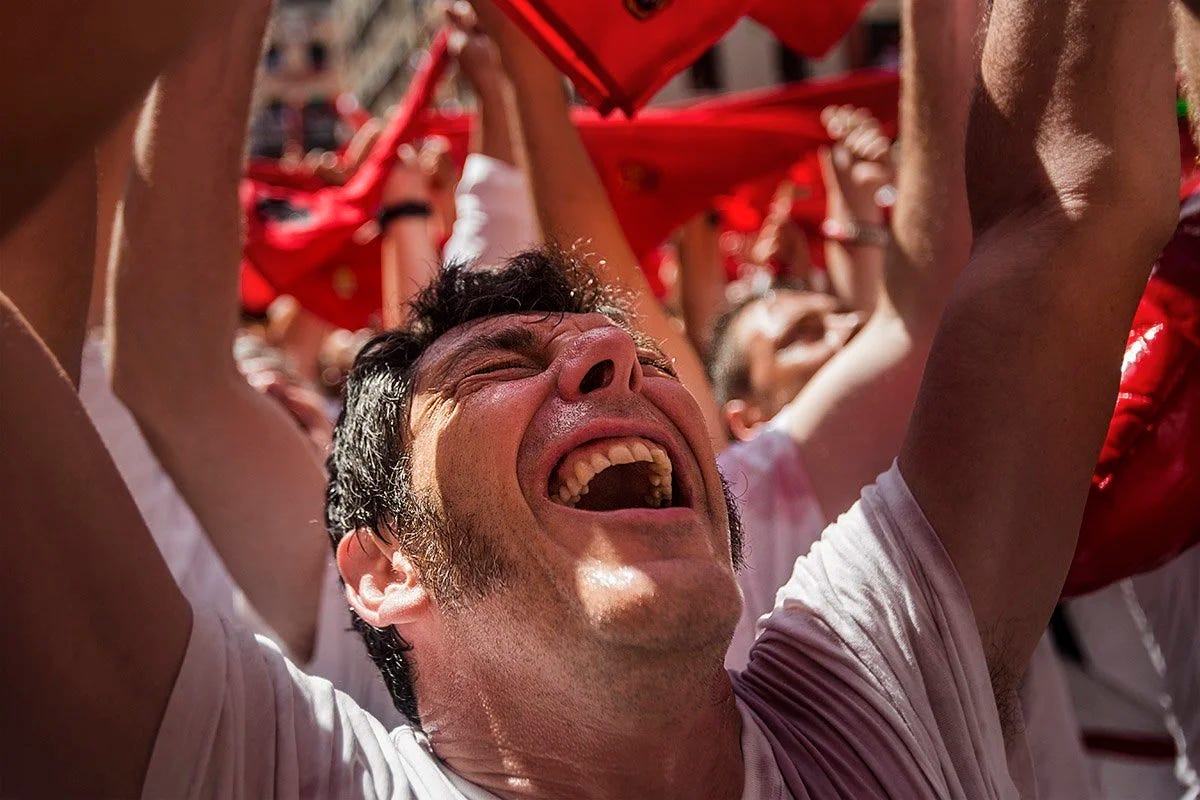
The Txupinazo opening ceremony, July 6. Photograph by Jordi Cohen Colldeforns
AT THE BREAKFAST tables on Calle de la Merced, I hear someone refer to San Fermín as “Hemingstein” – that is, a monster of Ernest Hemingway’s making. English-language writers and filmmakers have been drawn to the festival ever since Papa chose it as the backdrop for his 1926 novel The Sun Also Rises, but what was once a site of literary pilgrimage has become its own creative industry. Alongside Hillman’s latest book, this year brings the wryly humorous Bulls Before Breakfast by Peter N. Milligan, a Philadelphia lawyer with more than 70 runs behind him, and a feature-length documentary, Chasing Red, by Dennis Clancey, a 32-year-old Iraq infantry veteran who now leads Team Rubicon, a nonprofit specialising in disaster response.
Would Hemingway have approved? Well, one Hemingway does. John, son of Gloria (née Gregory), Ernest’s youngest child, has been attending since 2008. He runs – something his grandfather never did – with a ragtag collective of newcomers and old hands called the Pamplona Posse, the drinking man’s cuadrilla, who were my own introduction to fiesta.
In his memoir Strange Tribe, John writes movingly about his family, its almost imponderable dysfunction in particular, but here he wears the name lightly and is never in a hurry to volunteer it. He felt no blood obligation to turn up to San Fermín – a friend talked him into it – and his attachment to the festival is the same as every other returnee’s.
“It took me a while to adjust to the weight the name has here. When I first came to Pamplona I did a lot of media, and by the end of fiesta people were stopping me everywhere. In Montreal, where I live, the name carries… let’s say, considerably less charge. Things have settled down since that first year, which is good because I just want to enjoy it like anyone else. The camaraderie, the friendships, the atmosphere of a nine-day party that is at once pagan bacchanal and Christian festival – and of course the encierros and the corridas – I love all of it.”
CORRIDAS: THAT’S right, bullfights. Tauromachy isn’t what this piece is about, but it can’t be sidestepped. Anyone who visits Pamplona contributes to it, even if they’re not applauding the matadors, and the runners form a moving cog in the whole enterprise. I’m not about to argue bullfighting’s case, but I’m willing to defend my own.
There is much about the corrida that discomforts me. And much about it that fascinates me. Often they are the same thing. “Bullfight” is a misnomer: the corrida isn’t a fight, unfair or otherwise; it is a dance of death, highly stylised, its steps going back centuries. It offers no apology for what it is and, when poorly mounted – with sloppy bulls and bungling matadors – what it is can be very grisly indeed. Aficionados aren’t in it for the gore. They come for shows of grace, bravery and artistry under siege (every matador is gored once a year on average, and the death toll would be far higher without modern medicine).
Opposition to bullfighting is widespread outside Spain and growing within it (Catalonia banned it in 2010). For the past 14 years, on July 5, the animal-rights group PETA has staged protests in Pamplona to headline-grabbing effect. Their invariably semi-naked displays of outrage have become part of the festival calendar. Depending on the number of breasts on show, locals either shrug, clap from bar doorways or, elbowing past photojournalists, turn the Plaza de Toros into a soft-porn shoot.
An unrepentant propagandist outfit, PETA would have you believe the bulls are routinely nobbled – beaten with bats, doped, their horns shaved, their eyes smeared with vaseline – before they enter the ring, ignoring the fact that spectators can spot a fix with their eyes shut and that there is serious money riding on good, clean contests.
I watch a few of the corridas. The arena, which seats 19,700, is mostly full. The aficionados I’m sat with talk me through the action, though they’re united in wishing there were more of it, and better. A star cast of matadors – Juan José Padilla, El Juli and Miguel Ángel Perera – put in poor performances against below-par beasts. It carries the taint of a blood-spattered circus.
Known affectionately as “the Cyclops of Jerez”, after losing his left eye to a horn that tore it from the socket, Padilla can draw and hold a crowd, but the aficionados want art – vigorous bulls, audacious caping, clinical kills – not a ringmaster.
I talk it over with a friend of Padilla’s, Alexander Fiske-Harrison, an Old Etonian whose own bullfighting apprenticeship formed the basis of his book Into the Arena. Now 39, he saw his first corrida 16 years ago and didn’t fall for it immediately.
“I saw many moments of brutality, but I was surprised to find I could also perceive, intermittently, a kind of beauty that was entirely new to me. Each time I went back thereafter, I went with a little more understanding and a little less aversion. Had I become more sensitive to the aesthetics or more inured to the ethical implications of the fight? I don’t know.”
“Meat-eaters¹ may want to bear in mind that the toro bravo pays for its five years on the ranch with 20 minutes in the ring. The beef cow is put out of its misery after 18 months in a factory farm. And the bulls are eaten. The meat is sold before they enter the ring, which is licensed as an abattoir under European law [bullfighting grew out of the slaughterhouses – the mataderos – of Seville]. But even if that weren’t the case, the argument that killing for food is somehow different from killing for entertainment is bogus. We eat meat because we like the taste – it’s entertainment for our palates.”
As for encierros, they take place all over Navarre (close to 1,500 will be held this year), and Fiske-Harrison, who has stayed trim enough to run in his last school blazer, has tried his legs in the taurine fiestas of Tafalla, Tudela and Falces (where mozos career down a precipitous mountain path that drops sheer on one side); as well as in Cuéllar, in Old Castile, where, in Spain’s oldest documented bull run, toros are herded a little over three miles by some 200 horsemen through pine forest and across stubble fields before they reach town.
“I was watching from the point where the horsemen hand the bulls over to the men on the ground. It was like the cavalry charge scene in David Lean’s Lawrence of Arabia – this army of horses, their riders carrying lances to protect their mounts, coming down the dusty slope into town alongside a stampeding herd of cattle. As Hemingway said of Pamplona when it still applied, it was ‘the real old stuff’.”
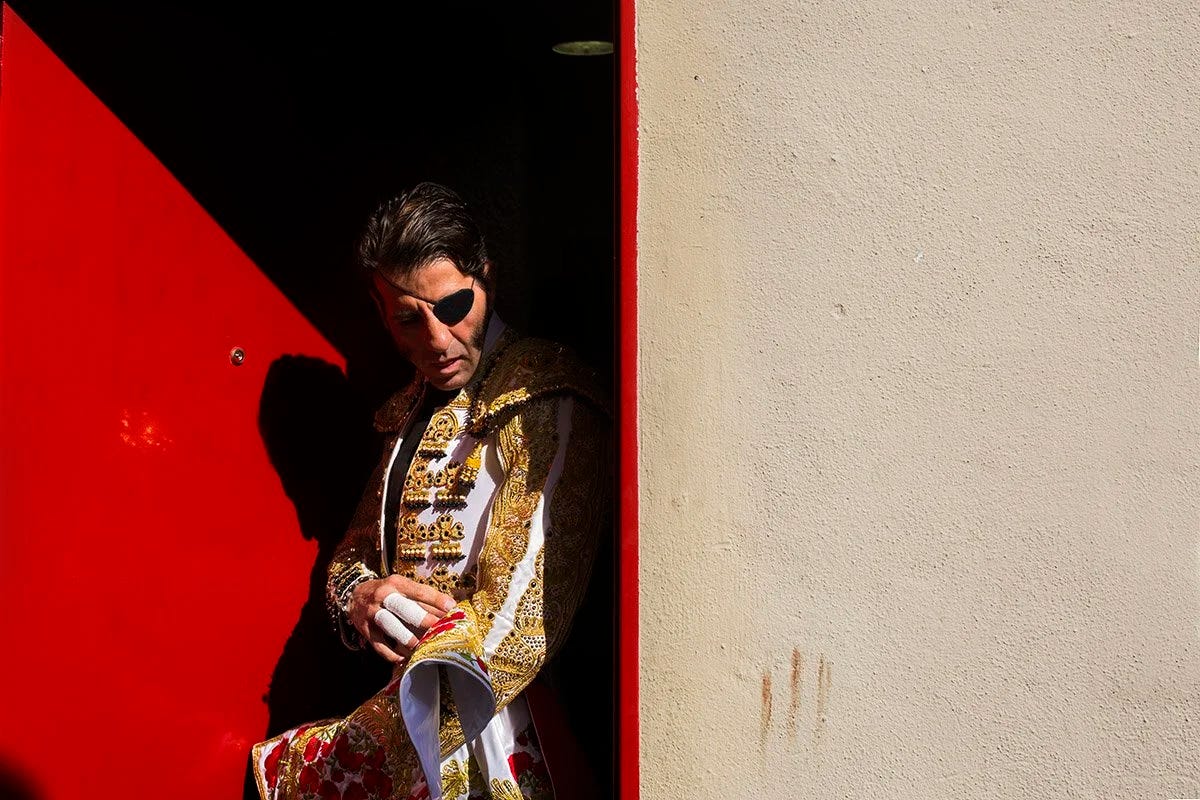
Juan José Padilla, “the Cyclops of Jerez”. Photograph by Jordi Cohen Colldeforns
DAY EIGHT AND it’s my fourth run of the festival. Two days earlier, during my third encierro, the bulls of José Escolar, Pamplona debutants, caused grave disquiet when one of them, the aptly named Curioso, stopped on Santo Domingo, turned around and headed back towards the corral. The mozos were braced for a suelto to come tearing up the street at any moment, but the bull was so agitated it was decided he would take no further part in the morning. With four gorings, the encierro had already been a lively one, so perhaps it was felt the runners had given their pound of flesh.
With only one previous San Fermín to their name, today’s bulls, from the Garcigrande ranch, are no veterans, but a Basque friend who has seen them in the ring tells me they’re not easily distracted.
I’ve avoided calamity so far, but no two runs are the same, even if the “rules” don’t vary much: run fast and true, which means getting in no one’s way, and if you take a tumble, stay down, as flat as you can. You’re unlikely to be scooped up or take a hoof print between the shoulder blades, because bulls – for all they’re happy to impale a vertical runner – have poor vision and are picky about where they put their feet.
I wonder, not for the first time, what I’m trying to prove, and to whom. My first encierro was in 2013, six months after I came out of a coma. Three crackheads had put me there – they were menacing a young woman with a hammer and a plank of wood, and when I intervened they turned the weapons on me. The blows fractured my skull and I was left for dead on the pavement.
True to form – I have a habit of mining humour from calamity – I still find it darkly apt that it happened outside Jack the Clipper, a Whitechapel barbershop that advertises “the closest shave of your life”. When I told my daughters I was going to Pamplona, they joked that multiple bangs to the head had not brought me to my senses. But they were not happy, and neither should they have been.
Fact is, I’ve courted danger since I could tie my own laces – or, preferably, leave them untied. I have a “death wish” every bit as greedy as a Hollywood sex drive. My doctors agree it comes with my “mental health condition”, bipolar 1 disorder. It can present as suicidal, but I’m not. My mania has no interest in my extinction. It simply understands that death’s proximity can sharpen one’s appetite for living.
For what it’s worth, death could not care less about my fourth run, but embarrassment – the death of dignity – sees its chance. The Garcigrandes keep tight to the right on Santo Domingo, horns striking the wall and throwing off the odd spark, and I veer further right still, preparing to meld with the masonry, when I’m abruptly wedged between a heavy-set Frenchman and a cast-iron drainpipe. I feel something pop.
Adrenaline keeps the extent of the damage – two cracked ribs – a secret for a while. Of course, it makes laughter – yawning, coughing, leaning over to type this – a distinctly unfunny business, but as San Fermín sorrows go, it’s the equivalent of denting a bumper in a 2,000-car pile-up.
Regardless, I carry it like a war wound, clutching my chest as though a bullet has just zipped through it. I spend the last day of fiesta not running with the Miuras but eating pintxos, watching swifts perform flights of fancy over the Arga river and drinking patxaran (a sloe-flavoured anisette liqueur I suspect contains traces of fly agaric and H. P. Lovecraft). At the back of my mind is the evening’s closing ceremony in the Plaza del Castillo, where a mournful crowd will raise its pañuelos and sing its farewells to the fiesta and to each other as the sky prepares to fill with fireworks.
THE WEATHER breaks after ten days of swampy humidity as I lug my laundry – like it will ever see white again – to Pamplona bus station. It’s an Old Testament production, the rain coming down like judgement on cobblestones that, when refreshed, reveal the ghost-prints of every bone that has broken against them. Thunder shakes its metal sheet and all the children clap. It sounds like a convoy of bin lorries – or a herd of Jandillas. I turn quickly, hoping to sneak one last look at Brigadoon, but it has already slunk off into the mist, leaving nothing but a whisper on the air: “¡Ya falta menos!”²
Sixty Minutes, Australia, 2013: an interview with Larry Belcher, the very best of men
The header photograph is of my friend Sam Lights on the fourth day of the last Sanfermines I attended, in 2017 (credit: Javier Martínez de la Puente). Few photographs capture the alegría of the encierro quite like this one.
¹ After this piece ran, I received a stack of death threats. These days, in the era of social media and armchair militancy, death threats lack the sting they once had, and I read mine with something like sympathy. I now need evidence of purpose – or at least a decent life – before I tuck into anything that once drew breath, unless I’ve killed it myself. A poacher uncle taught me early on to take the deaths that sustain me very seriously.
I didn’t welcome the threats I received from vegans, but I understood them (though if they stuck religiously to their least-harm principle, in a wider – planetary – context, they’d be too busy killing themselves to kill me). The only creature I harbour any real animus towards is Homo sapiens. Trouble is, it’s illegal to hunt humans and I doubt I’d be able to stomach eating any of the people I’d shoot with an untroubled conscience.
² Meaning “not long now” or “it’s almost here” – it marks the countdown to fiesta.